
Pesto needs no introduction but Hari Chutney, for those of you who don’t know, it is a coarsely ground condiment made with fresh herbs and spices, that is consumed as an accompaniment with all meals everyday in India. ‘Hari’ means Green and ‘Chutney’ means a flavorful condiment in Hindi (the Indian language). Freshly prepared in North India every morning, traditionally with a mortar pestle, the meals are incomplete without the zingy freshness that the chutney brings to the palate.
Don’t fret, I will give you my recipe for Hari chutney but you’ll have to read the full blog for that. It’s in there somewhere and that can be your little culinary keepsake 🙂
However, this blog is a little deeper than just the what these condiments are. The thought occurred to me while eating hari chutney during a typical Indian dinner and no – it was not butter chicken. We do have more dishes than that :)! Hari chutney is comfort and synonymous to home for me and I assume its the same for many more of my fellow Indians. Made with coriander leaves, mint leaves, lemon juice, garlic, ginger and chilies crushed into a paste like flowy consistency, I thought, hey! isn’t pesto also somewhat similar. Obviously not the ingredients! but isn’t pesto also paste like consistency and most importantly Green??
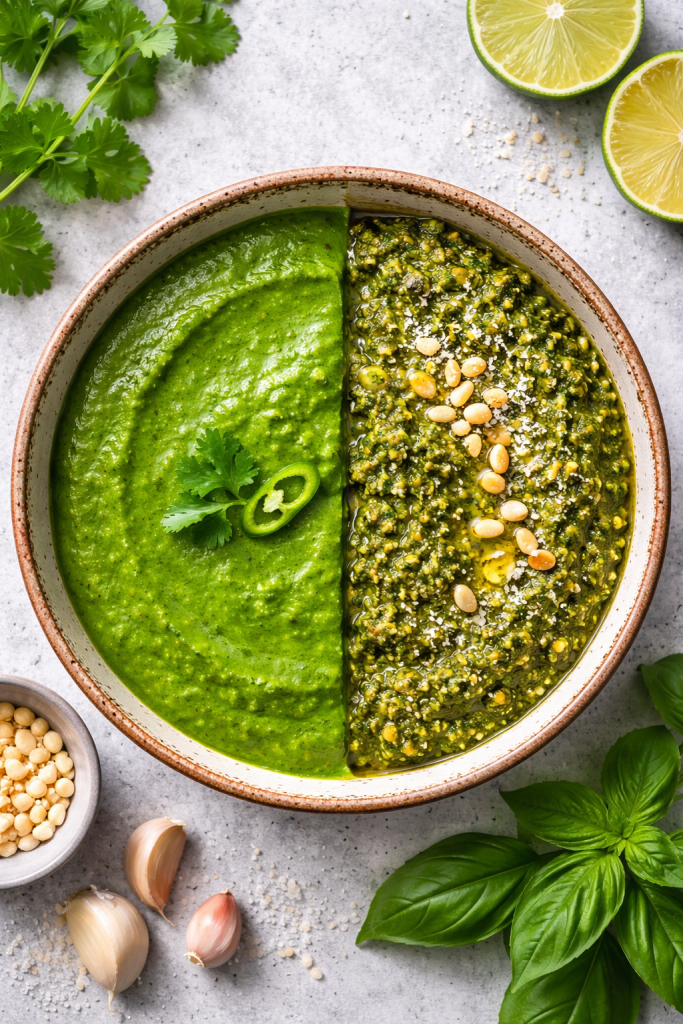
And then it hit me, Maharashtra in Western India has ‘Thetcha’ (pronounced like teyy-cha-ha), which is garlicky goodness made with chilies, peanuts, coriander leaves and salt, all coarsely ground into a thick paste like texture. Spread on a parantha or just as is, it makes the palate sing every time. Then I thought hey- Mexican cuisine uses ‘Salsa Verde’- a spicy green sauce used as a condiments for tacos, burritos, consisting of tomatillos, jalapenos, onion, garlic, cilantro, lime juice and spices (pretty similar to Hari chutney right?). I am no expert on cuisines so I will leave that to my fellow readers to educate me on in the comments. The Italian version of salsa verde uses fresh herbs, capers, lemon, and garlic.
Did you know that Salsa Verde in Spanish and Italian, both, mean “Green Sauce”. Hari Chutney also means Green Sauce. Someone certainly spent a lot of time naming them :’) (please note the sarcasm). However, the same amount of thought that goes into naming these also goes into making these “Green sauces” are quick and easy to make and can be prepared in a matter of minutes.
On the top of my head, I could count 5 Green sauces used in cuisines world wide, so how many more could exist?! This led me to online adventure of researching how many cuisines use a Green condiments. Well here is a few more – Zhoug is used in Middle Eastern cuisine and is made using jalapeno or green chilies, cilantro, parsley, lemon juice and warming spices like cardamom and cumin. Certainly the cardamom adds a different flavor profile and I cannot wait to try this. It reminds me of a blend of Mexican salsa verde and the Indian Hari chutney with a middle eastern touch.
Then comes your chimichurri, a well known green sauce made with parsley, olive oil, garlic, lemon, oregano – zesty and often served with grilled meats. The green goddess salad dressing, originating in the USA, is something I actually only got introduced to in the UK while eating the green goddess salad from M&S Foods – a must try! The dressing is vibrant and creamy and as all other green sauces go, it uses lots of green leaves of parsley, chives, tarragon. Typically made with a base of mayonnaise and/or sour cream/yogurt, garlic, lemon juice, and often anchovies. I did not think I would ever corelate this to Hari chutney but I guess it all ties together now! As far as similarities go, a variation of Hari Chutney also adds curd to it.
I think by now we all know that the similarity between our green sauces are – they are green. Meaning they use fresh herbs and lemon juice – very often! Another similarity is that these sauces, as the name suggests, are sauces. They are not used as main dishes but as accompaniments that elevate the dish and add freshness.
The blog highlights the diverse cultures yet the shared love for our green sauces or as one may say – our hari chutneys. The world may be divided by its diverse cuisines, each dish is a reflection of it’s country’s culinary artistry however, our green sauces share an unexpected similarity across the globe. Diverse cultures, brought together by a shared love for green sauce! It does not stop there – the best part is that every green sauce has its own variation in each household within its culture.
Please feel free and include your “Green Condiment” and drop your country next to it!

 All Little Things
Leave a reply to kalra.verendra Cancel reply